Monday, April 16, 2012

If You Can't Say Anything Nice, Say It Loudly


Every trip to the mailbox is an adventure when you’re the HoseMaster, and not just because it’s where my little alien friend lives. I call him W. Blinky Gray because he’s very small, has a gigantic head, loves the sound of his own voice, and hurls little tiny turds at me. No, it’s an adventure because I never know when I’m going to receive yet another nasty piece of hate mail. I’m not sure what I do to deserve the deluge of dislike I endure. I try to remember the advice my late mother always offered, “If you can’t say anything nice, say it loudly.” Here are some wonderful examples from my recent foraging among my voluminous hate mail.


I guess I should have expected this one…

Dear HoseBastard,

Sure, you make fun of me going to prison, but you don’t know the half of it, Fart Water. Those 2009 Bordeaux that Mr. Big Shot RP (Ridiculous Palate) gave those inflated scores to, guess where he got ‘em? Yup, that’s right. I sold them to him. All 19 of them! And they were all Pontet-Canet I bought for $50/btl at BevMo and recorked and relabeled at my house in Altadena. Funny, right? Everybody’s giving him crap for giving them all 100 points, but why wouldn’t he?—they’re all the same damn wine! Starts to make sense now, doesn’t it? Hey, give it to the guy, he’s consistent. He knows the same damn wine when he tastes it. He just doesn’t know it’s the same damn wine. Oh, the 99+ wines, those were Pontet-Canet mixed with Yellow Tail Shiraz. Shit, the thought of Yellow Tail makes me feel lonely here in prison.

And like I’m the only fraud out there. What about you? You steal jokes and relabel them, what’s the difference? All I did was give people cheap thrills, mostly shithead Millenials who think Dujac is that thing you put on your car that tracks it in case it gets stolen. Sure, they busted me for making a stupid label mistake, but there’s a lot of wine out there that is fake. I’d estimate that 90% of the pre-1965 Burgundy sold in restaurants is fake. Funny thing is, the fake stuff tastes better. Take it from Dr. Conti, the only thing that smells worse than forty year old Burgundy is orange wine. Orange wine! How stupid is that? It’s the wine equivalent of white people appearing in blackface.

If I were you I’d be careful about calling people frauds, HoseMustard. What I did made people feel better about themselves, which is more than you can ever say. I made those suckers feel important. Ten dollar wines can’t do that unless they’re labeled like thousand dollar wines. I made those guys feel better about themselves. I did it to be nice.

Sincerely,
Dr. Conti aka Rudy from “The Cosby Show”


I confess this letter came as a complete surprise. I wonder who wrote it for her…

Dear Mr. HoseMaster,

The most important grape in Napa Valley is Pinot Noir, and like that native of the Loire Valley, the Wall Street Journal strives to be the most important voice in wine journalism. I write simply and directly, making certain that I convey my facts gently and concisely to the highly educated swindlers and Mammon worshippers that read our publication. I’d appreciate it if you’d refrain in the future from pointing out the dullness of my subject matter—I choose my subjects only to highlight that same dullness in my voice. It’s called WRITING!

If you read my work carefully, which only requires an elementary school education and a truckload of NoDoz, you’ll discover that it is loaded with insight and surprise. For example, I recently wrote about Napa Valley Cabernet and revealed that many of those marvelous wines over $100 are blended with Merlot! I noted that it was a good way for wineries to unload their unwanted Merlot and, essentially, water down their expensive Cabs. You can only imagine the shock waves this caused in the industry. But there’s more to come. Just wait until I reveal that many of the Merlots are blended with Cabernet! I know, it’s hard to fathom, but this is the sort of back-breaking journalism I pride myself on. (Oooh, did you get that surprise? I talked about Merlot and then I said “Pride,” like the winery that specializes in Merlot. This is the kind of inside stuff I know those creepy suits who read WSJ won’t get, but I do it for all the wine experts that read my work. I’ve been told they laugh at everything I write! Isn’t that wonderful?)

Your blog isn’t funny, Mr. HoseMaster. What’s funny about, “She puts the ‘teague’ back in fatigue?” You’re a sad, pathetic blogger. You treat your readers, if you have any, like they’re smart and wine-savvy. I don’t think anyone likes that really. Not when you have the WSJ to teach you about wine.

Go fuck yourself,
Lettie Teague


Finally, a letter I will long treasure…

Dear Slut,
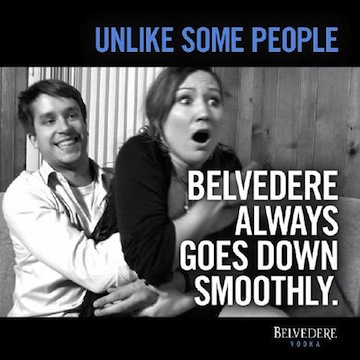
So the people at Belvedere call me to help with an ad campaign. We talk, and I realize we’re on the same page. We both want to bring back what this great country of ours needs now more than ever—misogyny. Our Forefathers, the men who wrote the Constitution and the Declaration of Independence and the original pilot for “The Jeffersons,” they were proud misogynists. They didn’t give women the right to vote, or to pursue life, liberty and happiness. Those things are for men! Misogyny is what this country has been missing the last forty years since those FemiNazis started taking over, though FemiNazis is an insult to my Third Reich friends. But, Sir, my friends in the media and I are bringing misogyny back, and bringing it back with a vengeance. And I’ll thank you and your stupid blog to stay out of it.

I’m going to be working with some wineries and some wine regional associations on ad campaigns as well. Wine is the bastion of men, like football and cigars and Oxycontin. I’m sure a jerk like you thinks women should be allowed to smoke cigars after sex. All of my ex-wives smoked cigars after they had sex—I could smell it on their clothes when they got home. And it’s just not right. It’s unnatural.

So here’s a couple of ideas I have for ad campaigns for wine that will help bring misogyny back where it belongs. I love Australian dessert wines, so how about a picture of a guy talking to a sexy girl at a bar and he’s saying, “I prefer mine sticky.” Hilarious, right! Or there’s this idea I have to sell Port. It’s a photo of two hot black sluts and the caption says, “You can have Ruby or Tawny any time you want.” Whoo, Boy, this is classic stuff. One more, one more… A picture of a broad wearing a short skirt swirling a big glass of red wine and the caption says, “It’s not the legs, it’s what comes between them.”

And once we get misogyny back, it’s on to killing miscegeny. Though that our forefathers liked.

You’re not funny and I’d have paid your mother to have used birth control,
Rush Limbaugh

Thursday, April 12, 2012

DIAL M.W. FOR MURDER


A HOSEMASTER OF WINE PULP FICTION CLASSIC

CHAPTER 3  Three Feet Under

Nothing cheers me up faster than a dame pointing a heater at my melon. Crystal was still sporting that dead smile, and the way she handled her piece I knew she’d had plenty of experience with guns. I was as nervous as Marvin Shanken at a harpoon factory. But I was having a change of heart about not wanting Crystal Geyser for a client. I was also definitely needing a change of underwear.

“Please, HoseMaster, I need your help. If  you don’t help me, I don’t know what I’ll do!” And with that, she aimed the gat at herself, the barrel gently pressed against her temple. I didn’t think she’d actually pull the trigger, splatter her brains all over my walls like a Jackson Pollack label for Mouton. But I wasn’t going to take any chances.

“Put the gun down, Crystal. I’ll take your case. I know I’m going to regret this. The whole M.W. game stinks like orange wine. But, hell, I’ve got nothing going on right now, maybe I can finally nail some of those pompous bung sniffers.”

I slowly stood up and walked over to Crystal. She let me take the gun from her hand. I could see in her perfect brown eyes, the color of 40-year-old Tawny Port, 20-year-old per eye, that she hadn’t planned on killing herself. There was a lot going on behind those eyes, a cold calculatedness that sent a shiver down my spine, like watching a sommelier walking toward you with a wine list. You want to run, but you don’t. And you end up enduring a long speech about the wonders of Grüner Veltliner, how versatile it is with food, which it is, if your dinner of choice is Tender Vittles. You should run. I should have run.

Crystal put her arms around me and pretended she was about to faint. I could feel my Tender Vittles tingling. She pressed herself against me; it was a very gentle press, and I was briefly fearful I’d release some free run juice. I could smell her skin, it had lovely minerality, like a Grand Cru Chablis, or maybe not, it was Les Clos call. She pulled me closer and I knew she wanted me to kiss her. Her lips were slightly parted, moist and beckoning. I knew it was wrong, but I kissed her. Her tongue threw out the Welcome mat and invited me to her tonsils. I explored the inside of her mouth like a lingual spelunker. My meat thermometer was harder than a barrel sample of Madiran. I could have taken Crystal right there in my office, but I have a rule about sleeping with clients. Not until the middle of the book.

“Thank you, HoseMaster, thank you. I knew you’d help me. When can you start?”

“Start? Hell, I’m almost finished.”

“I meant on my case.”

“Oh, I guess I can start right away. What was your friend’s name? The one who was murdered?”

“His name was Larry Anosmia.”

I was shocked. I knew Larry Anosmia. He was an M.S. I’d run into in an earlier case. Ran around with midgets. He even got shot because of me. And now he was dead, six feet under. I wondered what happened to the midget. Maybe he was dead, too. Three feet under. So Larry had decided to pursue an M.W., somehow met up with Crystal, was undoubtedly spraying his gunite in her wine cave, and ended up getting his throat slashed. Can’t say I’d miss him. Though at least now he’d finally become a good M.S. But I didn’t want Crystal to know I’d met Larry Anosmia before. I still didn’t trust her. I just hoped she was still going to be around in the middle of the book. Crystal was better endowed than Stanford University, and had probably received as many incoming freshmen.

“And this Larry Anosmia, where did you meet him?”

“At one of my wine tasting parties. I invite men who are studying for their M.W. over to my house and open rare wines for them. To help them study. It’s how I met all my friends who were murdered.”

“How many ‘friends’ of yours have been killed, Crystal? What kind of madness is going on with the M.W. program?”

Crystal’s eyes began to moisten. This time I didn’t think she was faking it. Had she really loved Larry Anosmia, and all the others? What kind of pathetic soul would fall for a bunch of wine dweebs? And how much could it be simple coincidence that Crystal had been involved with so many victims? And, why, I wondered most of all, was she so insistent about the HoseMaster being her private dick?

“Larry was the fourth.”

I didn’t want to be it, but I needed a fifth.


Monday, April 9, 2012

The HoseMaster's Most Important Wine Bloggers


Over at ImTanked, a blog written by a Social Media Expert (the word “expert” is appended to Social Media in exactly the same way “star” is appended to Porn), a recent post listed the “Nine Most Important Wine Bloggers in the US.” Must be nice to be the President of Wine and get to appoint the whole Supreme Court. The post resembles nothing so much as a fourth-grader choosing up sides for a game of kickball. “So I’ll take Alder because he’s my best friend, and 1WineDoody cuz he’s so cool and recommends wines to boys who like tits, and Tommy Wark—he uses such big words… But no girls! We don’t want girls on our team. Girl bloggers have cooties.” I’m also pretty sure the list was chosen by height, or lack of it. The nine bloggers standing on each others’ shoulders might not be able to unscrew a light bulb. Or a porn star.

The post is an exercise in the obvious, which, after all, is what wine blogging is about. I give its author, Paul Mabray, RFD, credit for that. Naturally, I was stunned and hurt that I wasn’t on the list. HoseMaster of Wine is clearly one of the Most Important Wine Blogs in the US, as well as many foreign countries, like Oregon. And I'm pretty short, too. But he has a right to his dull and predictable opinion. And, let’s face it, being one of the “Most Important Wine Bloggers” is a lot like being one of the “Most Interesting People in a Coma.” For members of either list, you can only pray for brain activity.

Naturally, I have my own list of Important Wine Bloggers. Behold!


Wright R. Block (www.aposteveryyear.com) –Block was the first wine blogger to stumble upon the idea of publishing a blog for the sole purpose of soliciting free tastings and samples from wineries. A title and a business card, that’s all you need. He ran out of ideas for his blog after ten posts, hasn’t run a new piece in four years, yet he continues to find ways to freeload in the wine business. An inspiration to all wine bloggers.

Heywood Jalookatme (www.simplewinesforsimpleminds) –Heywood stepped into the void left when Gary Vaynerchuk was moved to the Old Circus Chimps Home in Florida (where he roomed with the primate star of the old “Tarzan” movies—who says Cheetahs never prosper?). Heywood writes for the Everyman, speaking to ordinary wine lovers in language they can understand--monosyllabic. He may not have been the first to talk to wine lovers like they’re stupid, but he’s still the best. His style is widely imitated, as is his standard reply to critical comments, “Go Wark yourself.”

Luce Morals (www.winemakesmetingle.com) –Luce is certainly one of the most important wine bloggers. The first to ask readers to “join me on my journey to learn about wine!,” she inspired hundreds of new and equally worthless wine blogs. Now, five years later, Luce still knows very little about wine. But her relentless Tweeting and constant FaceBook posts rank her among the most influential wine bloggers as well. It’s Social Media, friends, it’s the quantity of the writing, not the quality.

W. Blinky Gray
W. Blinky Gray (www.blinkygray.com) –With his trademark eyeglasses the only thing giving away his cartoon roots, Blinky created the role of faux journalist among wine bloggers. Mixing a dull voice with his signature lack of insight, Blinky paved the way for an entire generation of frustrated high school newspaper reporters to discover wine blogging (which, in turn, led to PalatePress). That self-important tone so prevalent among wine bloggers? Thank Blinky. That air of superiority that masks a dearth of talent? A Blinky trademark! Ask him, he’s clearly one of the Most Important Wine Bloggers.

Flo Quacious (www.icantshutupaboutwine.com) –Flo Quacious invented the long form wine review, now a staple of wine bloggers. She can tell you less about a wine in 500 words than a professional wine critic can in 25. Every day she reviews a new wine and makes you think, “Why would I put that crap in my mouth?” But producers and importers of barely drinkable plonk love her style! After three paragraphs of a glowing review of yet another New Zealand Sauvignon Blanc that tastes mainly of Loudmouth Lime and Windex, who’s still awake to read that the wine was sent as a “Review Sample?" Flo made being bought for free samples a desirable path that hundreds of wine bloggers have since followed.

Haim Stevoff (www.haimstevoffhaimstevoffhaimstevoff.com) –Haim led the way for professional wine critics to cast aside dignity and join in the blogosphere conversation. A way to claim the ground that others broke, a way that an enormous number of successful wine writers have since followed. And why not? This road to the top is so much simpler! You already have the job that all the bloggers want, why not just butt right in and take away all their readers too?! Become one of the “Most Important Wine Bloggers.” It’s perfect. It’s like Meryl Streep stepping into the cast of “Happy Endings.” You’re surrounded by delusional people who think they have talent. Must be good for the ego.

Jose Maestro (www.JoseMaestroofWine.com) –You must be important if you can spend all your time making fun of everyone else, and that’s what Jose does on his eponymous blog. The poster boy for bloggers who think they have twice the talent they actually possess, Jose has a genuine gift for finding amusement where none exists. His claim that he doesn’t like any of his own work lands him squarely on the pulse of public opinion. It is a measure of his importance that, like all wine bloggers, he speaks to the 99%. The 99% of the country that hasn’t heard of any of them.

Addendum(b):
Here was the original manuscript for the post "The HoseMaster's Most Important Wine Bloggers"

9.
8.
7.
6.
5.
4.
3.
2.
1.


Thursday, April 5, 2012

The Man Who Mistook His Wife for a Spit Bucket--Part Two


Imagine wine critic Tim Foyer’s predicament. He now tastes wine as numbers. Once upon a time he drank wine for the pleasure it gave him, as it gives most humans pleasure.[i] After that, Tim became a critic for a major wine publication where his reviews had the capacity to make or break a winery. His palate was viewed by many consumers as skilled at detecting nuance and quality in wine.[ii] Now a neurological imbalance had Tim’s brain generating only numbers when he tasted wine. He wasn’t enjoying the wines at all. Which might be fine when you consider that a wine critic’s job is to ensure that others get less enjoyment out of wine.[iii] However, Tim’s job was at risk should consumers discover his puzzling brain malfunctions.

His newly developed disability had affected Tim in other ways as well. He seemed depressed, and not just from ingesting all of that alcohol.[iv] Tim’s self-perception revolved around his wine tasting abilities and the power he had in the wine business. He felt that slipping away, though, from what I could gather, it had been slipping away long before his recent taste problems had arisen. A new generation of wine consumers, from the so-called Millennial Generation, were getting their wine advice from other sources and ignoring the “wisdom” of the establishment wine critics. Foyer’s scores were having less and less effect. And his wasn’t the only opinion that had lost influence. Impotence was rampant among wine critics, which may have been age-related but was most likely caused by infrequent use.[v]

Tim worked for several years at his wine critic position while suffering from his very unusual affliction. He was experienced enough though, and well-versed enough in his chosen wine regions, that he could taste a wine, write down the number that instantly appeared in his mind, and then fabricate a tasting note. No one questioned his authority, or even bothered to read his tasting notes. In fact, it might take but thirty minutes of reading wine tasting notes for the average person to suffer some sort of brain damage.[vi] But Tim’s condition started to worsen.

Tim’s brain began to muddle everything to do with wine. At an important blind tasting of Sonoma County Pinot Noir, Tim tried to remove the corks with his publisher’s suspenders. An embarrassing moment ensued when Tim said to his boss, whose pants[vii] had puddled on the floor, “I can’t kiss it now, I’m trying to open these damned wines.” No matter how many times he was shown, he couldn’t recognize a corkscrew. He was certain it was Eric Asimov. An understandable mistake, but it won’t help you get the corks out of the bottles.

Mishaps with wine happened on a daily basis, but only with wine and wine paraphernalia. It was as though everything to do with wine for this major wine critic was a hopeless confusion. Yet, remarkably, he continued to rate wines with such conviction that no one suspected his brain disease. Consumers continued purchasing expensive wines unaware that they were following the advice of someone brain-damaged. Perhaps this is not so astonishing, as that has almost always been the case in the wine business.

The deal breaker came when Tim visited a winery with his lovely wife. He knew that he wouldn’t have to open any wine bottles himself, though he’d invited Eric Asimov along just in case, and that he wouldn’t have to do much more than taste a few wines, nod his head knowingly, pretend to write tasting notes in his journal, and spit. He usually spat anyway, and always pretended to write down tasting notes—he’d done that for twenty years. His host served him a glass of his finest Cabernet, hoping to impress the important wine critic. Tim savored the wine, swishing it about in his mouth, he thought only the number 91, and then he quickly and efficiently spit the wine all over his wife. He was certain she was a spit bucket, though she bears only a passing resemblance to one.

His wife, an innocent victim of his delusions, was astonished, but not more so than the winery owner when Tim said, “Hey, I’ve got Eric Asimov in my pants if you want to talk to him.”

Though I worked with Tim for many months, and ran many brain scans,[viii] I have never been able to pinpoint the cause of Tim’s problem. Perhaps it’s psychological, his desire to finally leave wine criticism before he becomes entirely irrelevant. Or maybe my hunch about a parasite is correct and his brain has been hijacked by a one-celled animal, similar to what happens to women who are groupies for serial killers. At this point, we don’t know. There are mysteries to the human mind that may never be solved.

Wine critics may just be one of them.


[i] It was Ben Franklin who said, “Wine is proof that God loves us, and really hates Mormons.” Which is miraculously prescient considering there were no Mormons at the time.
[ii] An opinion not shared by winemakers, unless they received a score of 95 or higher.
[iii] Numerical scores are seen by the critics who use them as “necessary and consumer friendly,” yet their sole purpose is to sell subscriptions and dictate consumer tastes. Which everyone managed to do for hundreds of years before numerical ratings.
[iv] Alcohol is a serious depressant, equivalent to thinking about Rick Santorum as President.
[v] See my article, “Soft or Firm? A Wine Writer’s Answer is ‘Yes’”
[vi] In a famous case, a man read an entire issue of  “Wine Advocate” in one sitting and subsequently believed he was a spice rack with balls. While ostensibly sad, he did spruce up the kitchen.
[vii] Originally made for Ringling Brothers
[viii] They all revealed Nothing.


Monday, April 2, 2012

The Man Who Mistook His Wife for a Spit Bucket


The brain of a wine connoisseur is not particularly complicated. It works the same as any other person’s brain only much slower. What is seen as contemplation, the thoughtful gaze of a wine expert as he sniffs, the eyes gazing into an unknowable distance as he tastes, the slow, measured writing of his tasting notes, is actually a sign that his brain is working more slowly than most. We are on DSL, the wine connoisseur is on Dial-Up. Neuroscience is only now beginning to understand why.

In the Fall of 2009, I received a letter from a renowned wine critic. It was almost unreadable, in the manner of wine blogs.[i] That is, it was dull and plodding, and overflowed with vestigial adjectives that made little sense in the context. For example, what did “hedonistic” have to do with “Merlot?” Or “unctuous” with “Jancis’ piehole?” It was apparent that the author of the letter, I’ll call him “Tim Foyer,”[ii] was desperately in need of help. I agreed to meet with him.

Tim had the haggard and world-weary look I associate with wine experts. Liver disease had given him a lovely yellow glow that kept away moths. When he smiled, his teeth were stained like he’d grown up chewing betel nuts[iii] and just this morning he had decided, like James Brown, that “Papua Got a Brand New Bag” of them. He was distracted, and I alertly noticed that, instead of pulling out his chair when we sat down, he pulled out his penis, twirling it around like a lasso, and then fell squarely on his buttocks. I was to learn later that this was a greeting favored at meetings of Master Sommeliers, though Tim wasn’t an M.S. and it was strictly a symptom of his illness.

I was to continue to meet with Tim to try and diagnose his condition over the next few months. During that time, I learned how his condition had slowly developed over the years; so slowly, in fact, that he didn’t really notice any changes in his behavior himself until the fateful day he mistook his wife for a spit bucket. It was that episode that finally sent him searching for help.

Tim had started his career as a sports writer, but drifted into wine.[iv] Through hard work and passion, he was soon one of wine’s most influential critics. A great review from Foyer was certain to sell hundreds of cases of wine. Wineries both courted him and feared him, but he had the sort of disposition that could handle the notoriety.[v] Yet he was starting to change, he told me, change he only now sees in hindsight.

It began with numbers. Tim often tasted a hundred or more wines in a day. He had trained his palate to work with his brain in an efficient manner, and he could quickly write descriptive, if unnecessarily florid, paragraphs about every wine he tasted. And then one day he couldn’t.

One day he put a particularly expensive bottle of Napa Valley Cabernet Sauvignon in his mouth and a number appeared, “96.” He couldn’t taste anything. Not cassis, not olive, not black cherry, not plum… His brain insisted on a number. Tim tried another Napa Cabernet, from a less prestigious winery. Slowly, remember he is a wine connoisseur, the number “93” was the result. He had no idea what the wine tasted like, it could have been Italian wine, or, God Forbid, Lake County wine, for all he knew. All that registered from the interaction of the wine on his tongue was “93.” He wrote it down. He would manufacture a description later.[vi]

For many decades now, wine publications have used numbers to convey the quality of wine. Could this be masking some kind of brain parasite spread at industry events? Perhaps as part of its reproductive cycle, the parasite alters the brain chemistry of the critic, rendering him unable to experience wine as normal people experience it, that is, with pleasure and without passing numerical judgment. Were all wine critics brain injured? Many wine lovers would say yes, and most winemakers as well.[vii]

I decided to first investigate whether Tim “tasted” numbers on other occasions. I asked him to lunch. I had him order a bottle of wine, which took him a very long time considering the fact that we were in a Vietnamese restaurant where the wine list was 90% Gruner Veltliner, which left only 10% wines made from actual wine grapes. When the wine arrived, I had Tim taste it. I asked him to describe the wine to me, its smell, its flavor, its texture. All he could say was, “88.” So the jerk ordered an 88 point wine that set me back $75. At that point I was sure his condition required Electro-shock Therapy, applied to his favorite lasso.

When our food arrived, I asked Tim to describe the flavors. He was quite articulate, describing his Clay Pot Catfish as tasting of “lemon grass, Thai chili, and a fellow bottom feeder.” He could describe the flavors of each dish, and he also commented on how my cologne smelled like “RuPaul’s gaff.” Yet the wine was a simple “88.”

It was obvious that something was going wrong in Tim’s brain. And that he didn’t know that much about wine. 88?


TO BE CONTINUED


[i] I wrote about wine bloggers previously in “The People Who Mistake Typing with Writing—Brain Damage or Cry for Help?”
[ii] Wordplay is an important tell when diagnosing raving idiots. What’s a synonym for “foyer?”  Yes, you’re on the right track, but the critic is not Jim Vestibule.
[iii] Not to be confused with Yoko Ono, who grew up chewing, well, you get the idea…
[iv] There are many drifters in the wine business. Most reputable wine writers acknowledge this and often put the wines they review in brown paper bags, the drifter’s trademark.
[v] Like many actors, sports figures and elected officials, other occupations loaded with people on Dial-Up.
[vi] It turns out to be common practice among wine critics to simply make a list of numbers for wines and then write some kind of imaginary description later. No one reads the descriptions anyway, sort of like footnotes, so this isn’t seen as disingenuous.
[vii] Though winemakers themselves often suffer from a different kind of parasite, which the French call “sommeliers.”